Why Mandala?
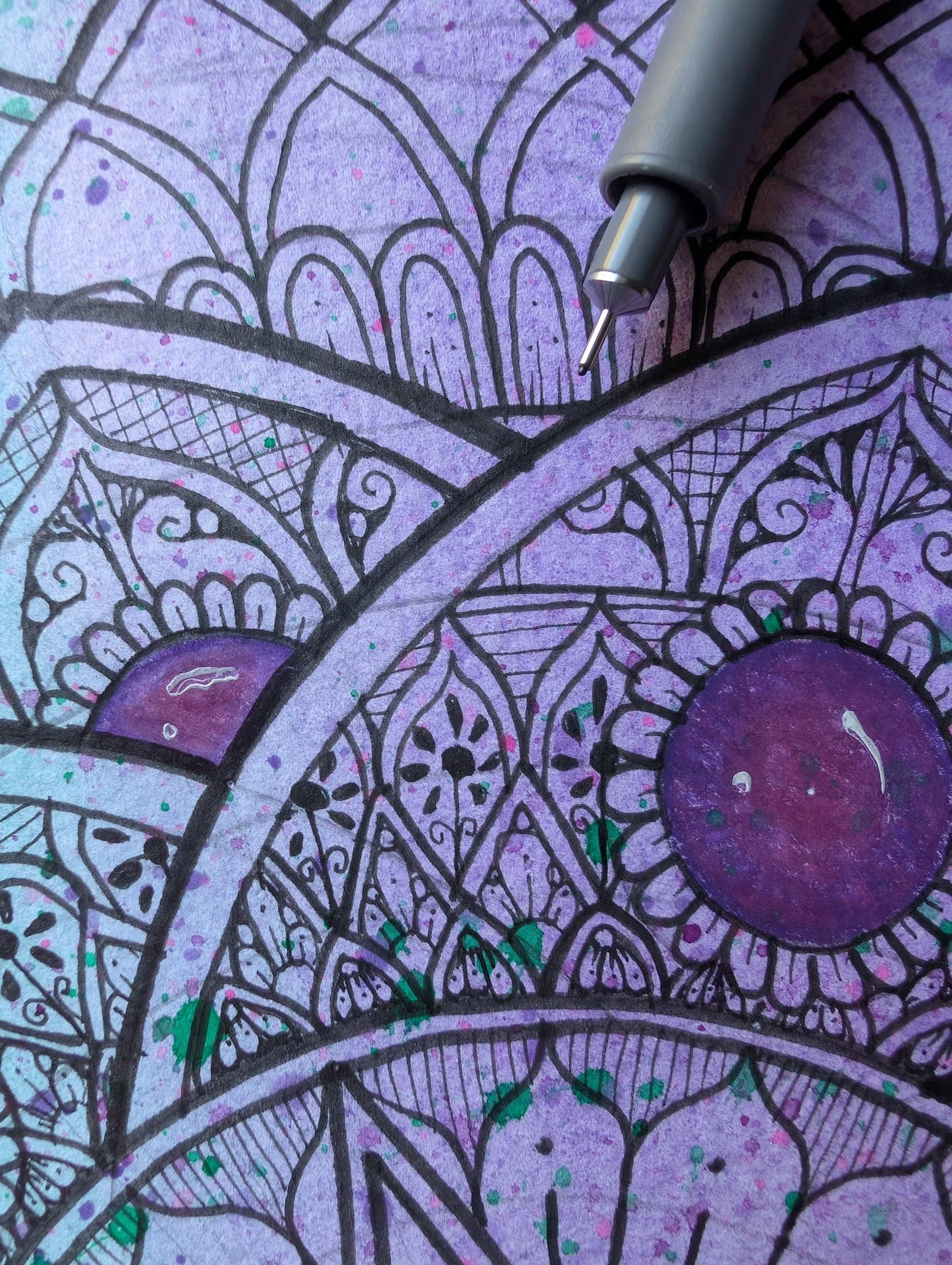
Mandala means circle in Sanskrit, the important part being the central point. I'm interested in mandalas and yantras in the Hindu traditions, in Buddhism, and also the rosette, rose window, and the labyrinth in the West and beyond. Mandalas are found in some shape (even square) in every culture and every era since the spiral of the Paleolithic caves of France and in the Neolithic period. They can be of any size, from smaller to huge: the giant mandalas of Manipur, India were discovered thanks only to Google Earth in 2013.
I'm interested in making mandalas as a practice of awareness in creating an object to meditate on. A mandala is a sacred space, in which we build ourselves from the inside out and from the outside in. It is the sacred geometry that connects us to the universal unconscious. To create a mandala is to build a microcosm that reflects the macrocosm, which then reminds us that we are part of something bigger than ourselves: that we are part of the whole.
The mandala is a visual prayer.
Looking at a mandala is observing the universe inside each of us.